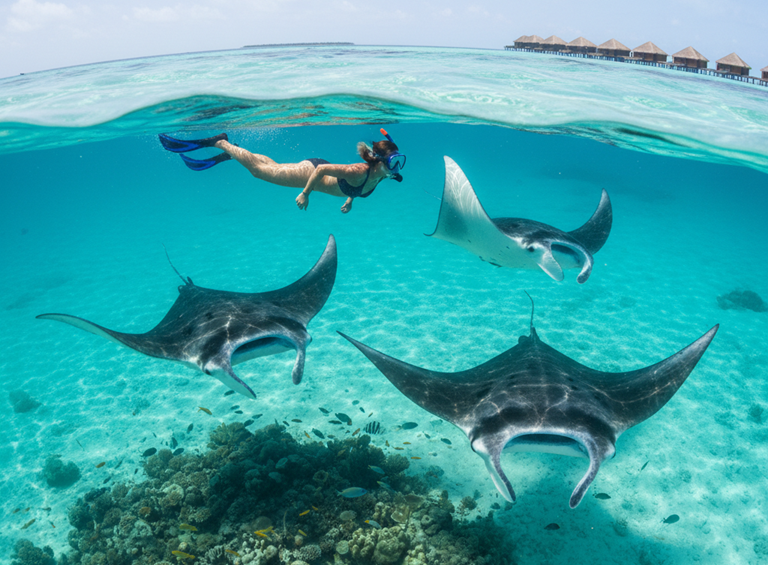
Would you like to swim with manta rays in the Maldives? You are in luck. In the Maldives, manta rays can be seen throughout the year. However, some seasons and locations are much better than others. Mantas follow plankton, their favourite food, moving according to the currents and the changing monsoon seasons.
The species most commonly seen is the reef manta ray, although in some southern atolls you may be lucky enough to encounter a giant oceanic manta ray. While reef manta rays usually reach a wingspan of up to around 5.5 metres and can weigh up to 1,400 kg, oceanic manta rays can measure up to 9 metres across and weigh as much as 2,300 kg. They are the largest manta rays in the world.
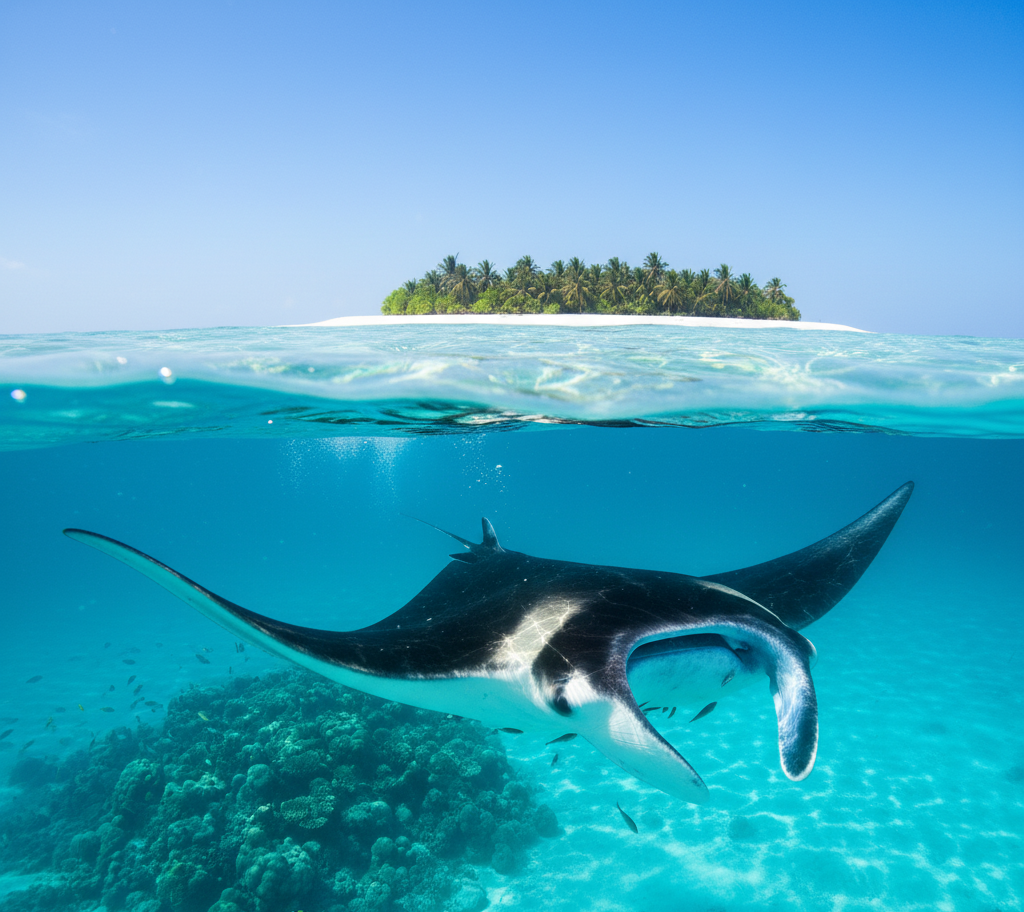
When Can You See Manta Rays in the Maldives?
- The best time to see manta rays in the Maldives is from May to October. Thanks to the plankton brought in by the currents, manta rays are more easily spotted along the eastern edges of the atolls, often in large groups.
- From December to March, sightings are less frequent, although you may still be lucky on the western edges of the atolls. The weather in the Maldives during these months is also excellent for diving and snorkelling.
- April and November are transition months, but there is still a chance of seeing manta rays.
No one can guarantee a manta ray sighting with 100% certainty, but by following these tips, your chances of seeing mantas during your holiday in the Maldives will increase significantly.
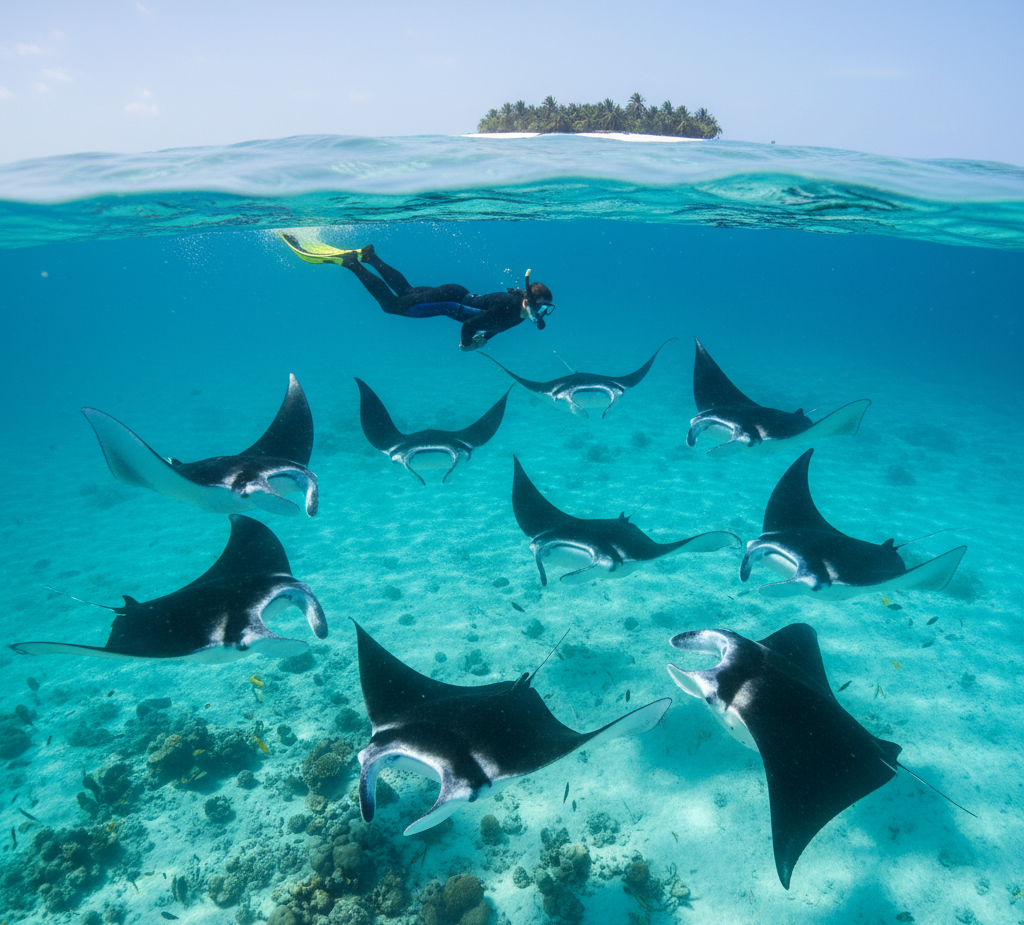
Swimming with manta rays in the Maldives is one of the most moving experiences I have ever shared with my son in this paradise. I was so overwhelmed by their majestic movements that, beneath my snorkelling mask, I felt a little tear of emotion escape.
The Best Atolls to See Manta Rays in the Maldives
The best place to see manta rays in the Maldives is Hanifaru Bay, in Baa Atoll, from May to November. In this protected reserve, you can snorkel with dozens, and sometimes even hundreds, of manta rays. However, only snorkelling is permitted here, not scuba diving. Access to Hanifaru Bay is also regulated by the government in order to protect the mantas.
Other top places to see manta rays in the Maldives include:
- Lhaviyani: If you are lucky, you may also see manta rays in Lhaviyani from October to April, particularly around Fushifaru, Dhanifaru and Kanifushi.
- Raa: Mantas can also be seen throughout the year in Raa Atoll, depending on the season. You will find them on either the eastern or western side of the atoll.
- North Malé: Especially from April to December at Lanka Manta Point.
- Seenu, in the south: Manta rays can be seen all year round, including some with a wingspan of more than 5 metres. It is an ideal spot if you are planning to dive in the Maldives.
Frequently Asked Questions About Manta Rays in the Maldives
The crown jewel is Hanifaru Bay, in Baa Atoll. From May to November, you can snorkel with dozens, and sometimes hundreds, of manta rays in this protected site. Please note that only snorkelling is allowed here, not scuba diving. Manta rays can also be seen in other atolls throughout the year, although sightings are generally less predictable.
Yes, but the best time and place to see them depends on the season and the currents.
Without a doubt, Hanifaru Bay during the rainy season, from May to November.
Yes, in most atolls. However, in Hanifaru Bay, only snorkelling is permitted.
The main species is the resident reef manta ray, although in Seenu Atoll, with a little luck, you may also see giant oceanic manta rays.
Manta rays can live between 40 and 50 years.
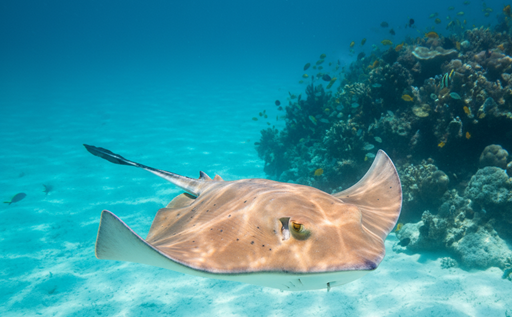
Manta rays and stingrays are often confused, but they are different animals, although both belong to the group of cartilaginous fish known as elasmobranchs. If you see a huge animal swimming in open water, with its mouth at the front and no stinger, it is most likely a manta ray. If it is smaller, stays close to the seabed and has its mouth underneath, it is probably a stingray.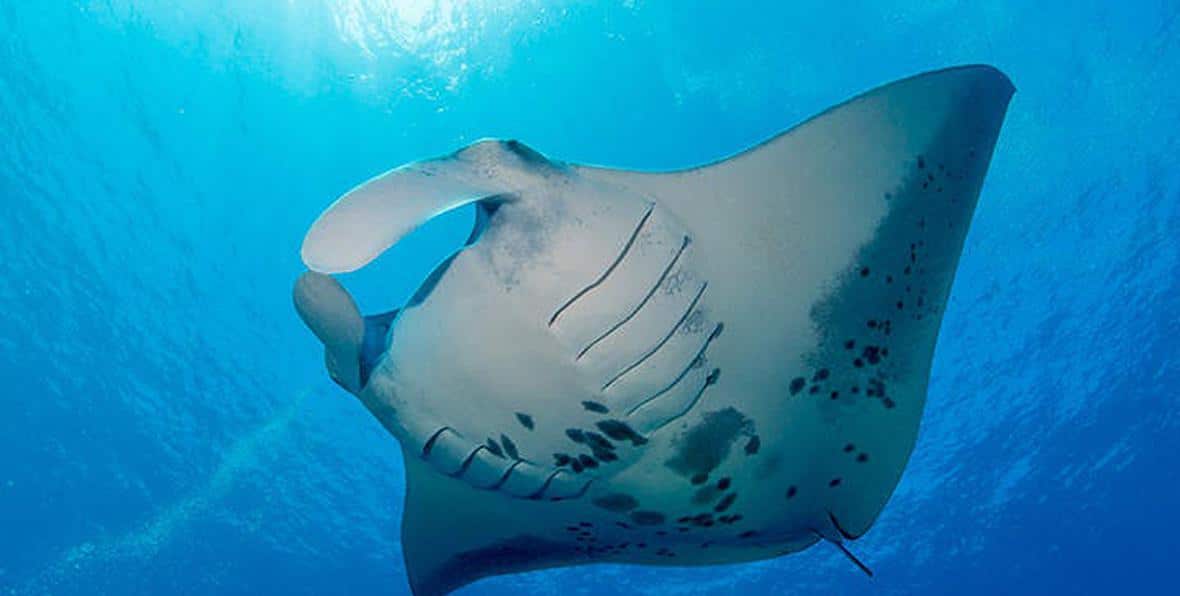
No, manta rays are harmless. They feed on plankton, are gentle and curious, and often approach humans, especially divers.
Stingrays, on the other hand, are carnivorous and can be dangerous if they feel threatened. They have a venomous barb in their tail that can sting. Although the venom is not usually fatal, it can cause pain and difficulty breathing. It is their defence mechanism. Stingrays are usually found on the seabed, moving through the sand in search of food, so it is important to be careful not to step on them accidentally.
Hanifaru Bay
The conservation and protection programme in Hanifaru Bay is one of the most important in the Maldives. Its aim is to preserve the unique biodiversity of this area, especially the manta rays and whale sharks of the Maldives.
In 2011, Hanifaru Bay and Baa Atoll were declared a UNESCO Biosphere Reserve, which means strict environmental protection rules must be followed and a sustainable economy must be promoted in order to prevent overcrowding and reduce the negative impact of tourism.
Its projects seek to better understand the behaviour of marine species in order to ensure their long-term protection. In recent years, the number of manta ray sightings in the Maldives has increased. Thanks to this programme, Hanifaru Bay remains a sanctuary for manta rays in the Maldives and an example of responsible tourism and marine conservation.
How Do Currents Affect Manta Ray Feeding in the Maldives?
The currents of the Indian Ocean have a direct impact on manta ray feeding. These currents carry large quantities of plankton, which is the main food source for manta rays. When currents are strong and rich in nutrients, plankton becomes concentrated in certain areas, attracting mantas to feed.
During the monsoon changes, the currents shift, determining where plankton accumulates around the atolls. For example, during the southwest monsoon season, from May to November, currents carry plankton towards the eastern side of the atolls. During the northeast monsoon, from November to April, they push it towards the western side. Manta rays follow these movements to maximise their access to food.
In places such as Hanifaru Bay, when currents and tides align, an exceptional concentration of plankton can occur. This can lead to unique natural spectacles, where dozens or even hundreds of manta rays feed together, sometimes forming synchronised spirals to filter plankton more efficiently.
In summary, currents not only determine where and when you can see manta rays, but they are also key to their feeding habits and group behaviour.